The Hair Type System Explained (1a–4c)
Walk into any conversation about hair care online and within minutes someone will mention being a 2b or a 3c. It's everywhere, but very few people actually explain what the numbers and letters mean or why they matter.
The good news is the system itself is straightforward, and once you understand where your hair sits on it, almost every product, styling decision and salon conversation suddenly makes more sense. Here's the plain-English guide.
Where the System Came From
The hair type system was developed by Andre Walker, Oprah Winfrey's longtime hairstylist, in the 1990s. He wanted a simple way to classify hair by its natural pattern rather than its colour or thickness, and the system he created is still the standard reference used by stylists, brands and beauty editors today. It groups hair into four broad types numbered one to four, with sub-categories a, b and c describing the tightness of the pattern within each type.
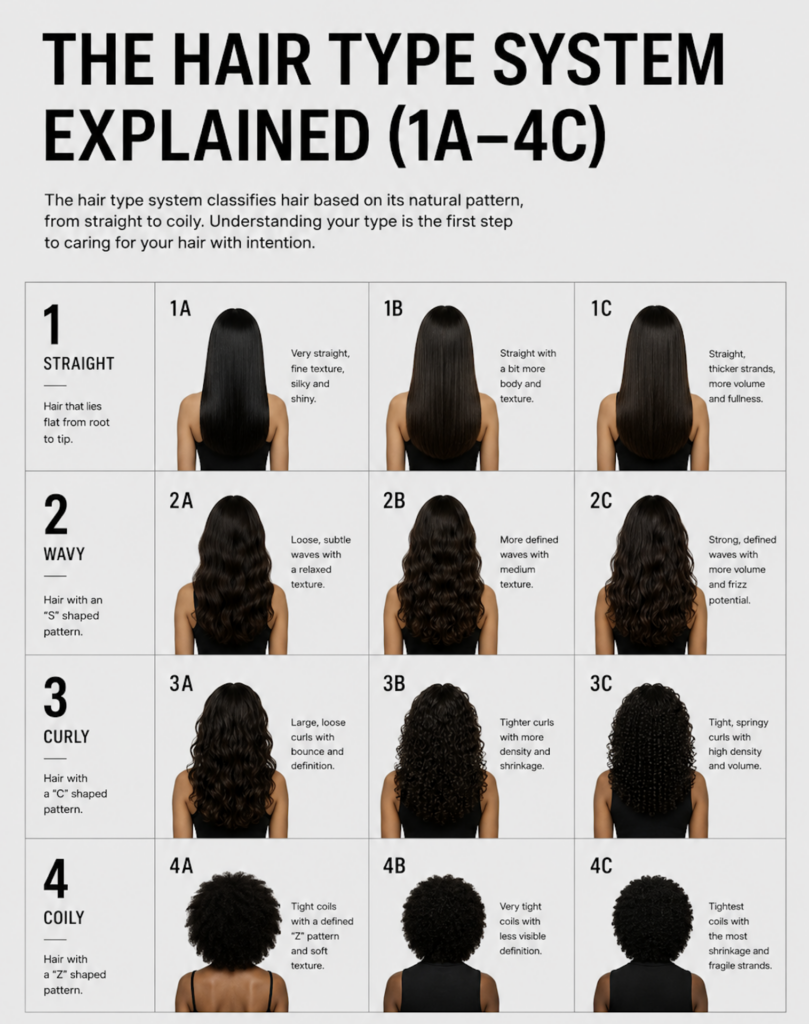
Type 1 is straight. Type 2 is wavy. Type 3 is curly. Type 4 is coily. The letters describe how loose or tight the pattern is within each category: a is the loosest, c the tightest. Most people sit somewhere on this scale, and plenty of people have more than one type across their head, with crown hair, nape hair and front sections often differing slightly. Knowing your type isn't the whole picture, but it's a brilliant starting point for understanding what your hair needs.
Types 1 and 2: Straight and Wavy Hair
Type 1 hair is naturally straight, with no curl or wave. 1a is the finest and most poker-straight, common in East Asian hair. 1b has a bit more body and the occasional bend. 1c is straight but coarser and more resistant to curling. The challenges with type 1 tend to be flatness at the root, oiliness travelling down the strand quickly, and difficulty holding curl when styled. Volume-building products, lightweight conditioners and avoiding heavy oils are usually the answer.
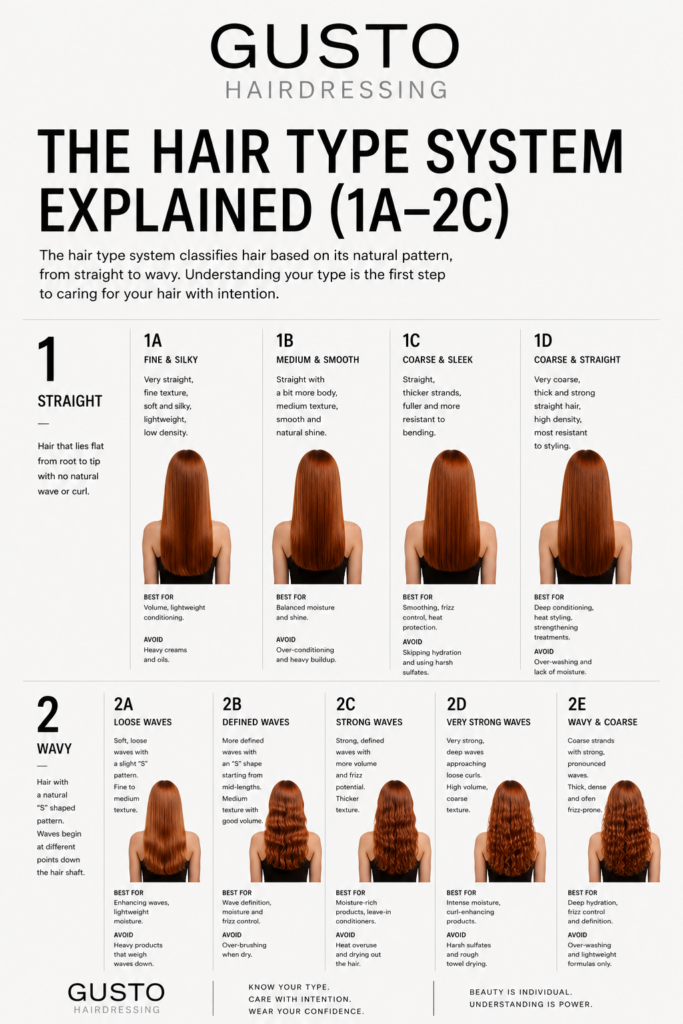
Type 2 hair is wavy. 2a waves are loose, soft and easily flattened by heavy products. 2b waves are more defined, often with an S-shape forming around the lower lengths. 2c is the most defined of the wave family, sometimes shading into loose curl, and tends to be thicker and more frizz-prone. Most type 2 hair benefits from lightweight curl creams, gentle scrunching with a microfibre towel, and avoiding too much brushing which knocks out the natural texture.
Type 3: Curly Hair
Type 3 is where genuine curl begins. 3a has loose, large, springy curls about the size of a piece of sidewalk chalk, with shine when looked after well. 3b has tighter curls roughly the size of a marker, often densely packed and with more volume. 3c is the tightest type 3, with corkscrew curls about the size of a pencil that hold their shape strongly when properly hydrated.
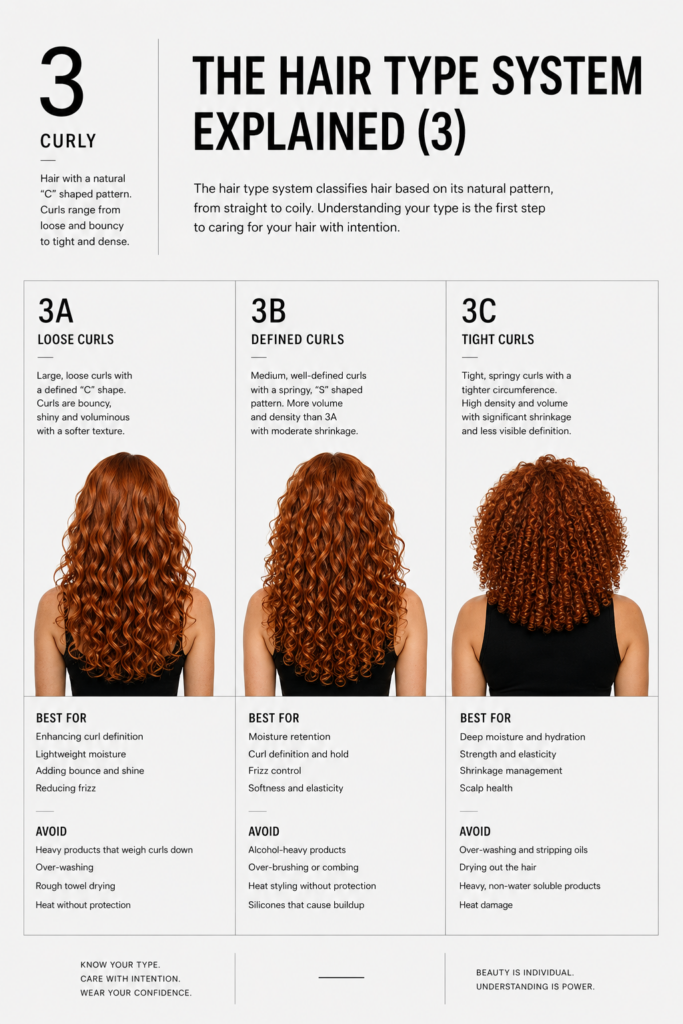
Type 3 hair almost always benefits from extra moisture, careful detangling on damp hair with a wide-tooth comb or fingers, and styling with curl-defining creams or gels. The most common mistake is treating curly hair like wavy hair, brushing it dry, or piling on too many products too quickly. Less is usually more, and a few well-chosen products applied in the right order will outperform a bathroom shelf full of half-used bottles every time.
Type 4: Coily and Kinky Hair
Type 4 hair has the tightest patterns of all and is often described as coily or kinky. 4a has small, well-defined coils about the size of a crochet needle, with visible curl pattern when wet and shrinking significantly when dry. 4b has a zigzag pattern rather than a clear coil, often very densely packed and with significant shrinkage. 4c has the tightest pattern of all, sometimes so tight that it appears almost as a Z-shape with less visible curl definition, and can shrink to a fraction of its actual length.
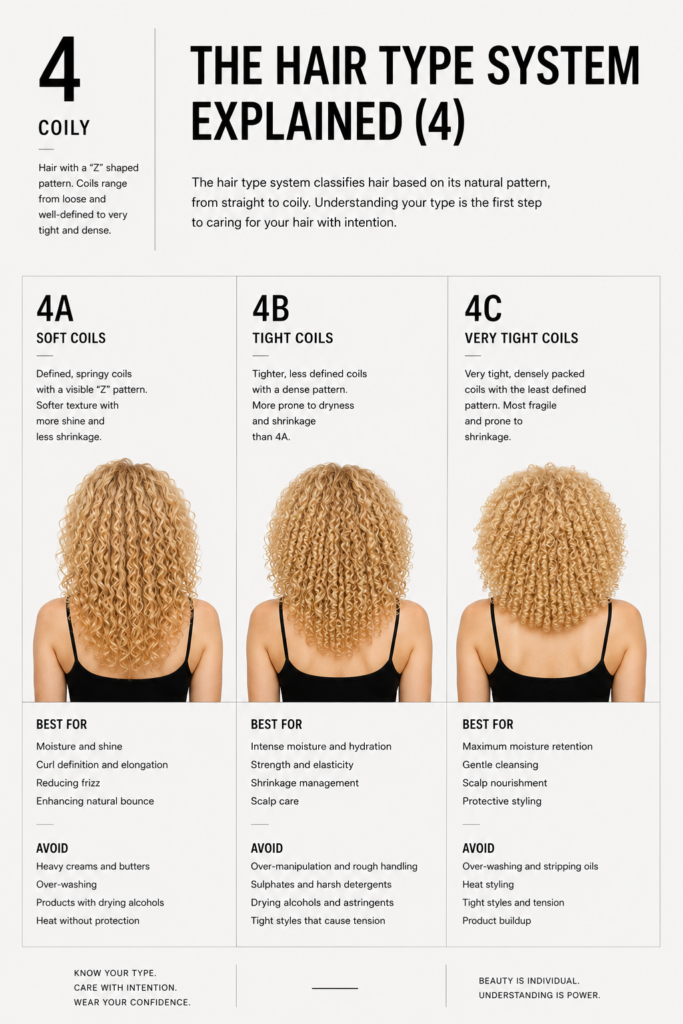
Type 4 hair is the most fragile of all the types because each tight bend in the strand is a potential weak point. It needs serious moisture, gentle handling, protective styling to reduce daily manipulation, and a deep conditioning treatment as a regular part of the routine. Working with hair when it's damp and saturated with product, rather than dry, is the rule. A skilled stylist with proper type 4 experience makes an enormous difference in cut shape, treatment and styling outcomes.
Why Knowing Your Type Matters in Salon
Knowing your hair type isn't about labels, it's about communication. When you can tell a stylist that you're a 3a in the crown and a 2c at the nape, you save twenty minutes of back-and-forth and they can plan your cut and treatment from a much more accurate starting point. Cutting techniques change depending on type. So do colour processing times, treatment formulas, and even blow-dry recommendations. A great cut on type 1 hair would be a disaster on type 4, and vice versa.
At Gusto Hair, our stylists work across the full spectrum, from poker-straight 1a through to densely coiled 4c, and every consultation starts with an honest conversation about your hair type, your routine, and what you actually want from your hair day to day. The system is just a starting point, but it's a really useful one, and the right stylist will build on it to give you a cut, colour and care plan that genuinely fits.
Want a salon visit that actually understands your hair? Book at Oxford Street | Book at Covent Garden.