What We Actually Do When You Walk In With Home-Bleach Damage
Every colourist in London has had this appointment. Someone sits down, pulls their hair forward over their shoulders, and says some version of "please don't judge me, I did something stupid." Usually it was a box of bleach, usually at about eleven o'clock at night, usually after a bad week.
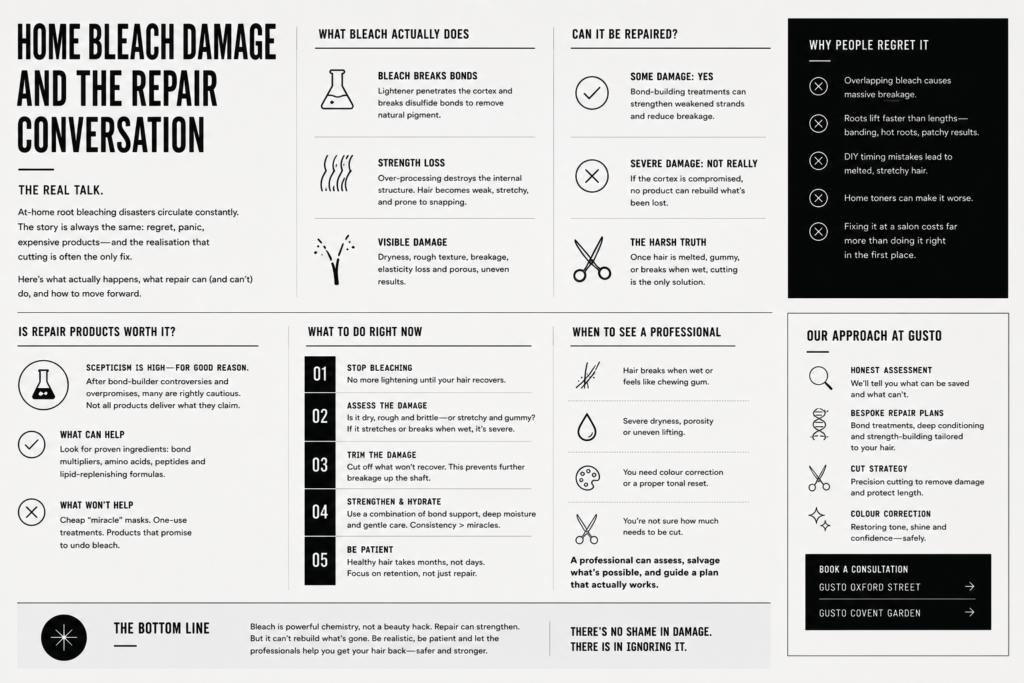
Nobody in this salon is going to tell you off. We have all seen far worse than whatever you are about to show us, and the telling-off does not fix anything. What follows is what actually happens in a colour correction appointment at Gusto, start to finish, so you know what you are walking into before you book it.
The first appointment is a consultation, not a fix
If you ring up and ask to have home-bleach damage corrected on Saturday, we will book you a consultation first, and it will be free. This is not a stalling tactic. It is the only responsible way to do it, because nobody can quote a price or a timeline for hair they have not touched.
In that consultation we want to know three things. What was on your hair before the bleach, including box colour going back a year or two. What exactly you put on it, and how many times. And whether anything has been applied since, particularly a "colour fix" or a toner from a chemist, because those change what we can safely do next.
Be honest about all of it. There is no version of this where telling us the truth makes the appointment worse. There are several versions where not telling us leads to a bad result, and one where it leads to breakage.
The strand test comes before anything else
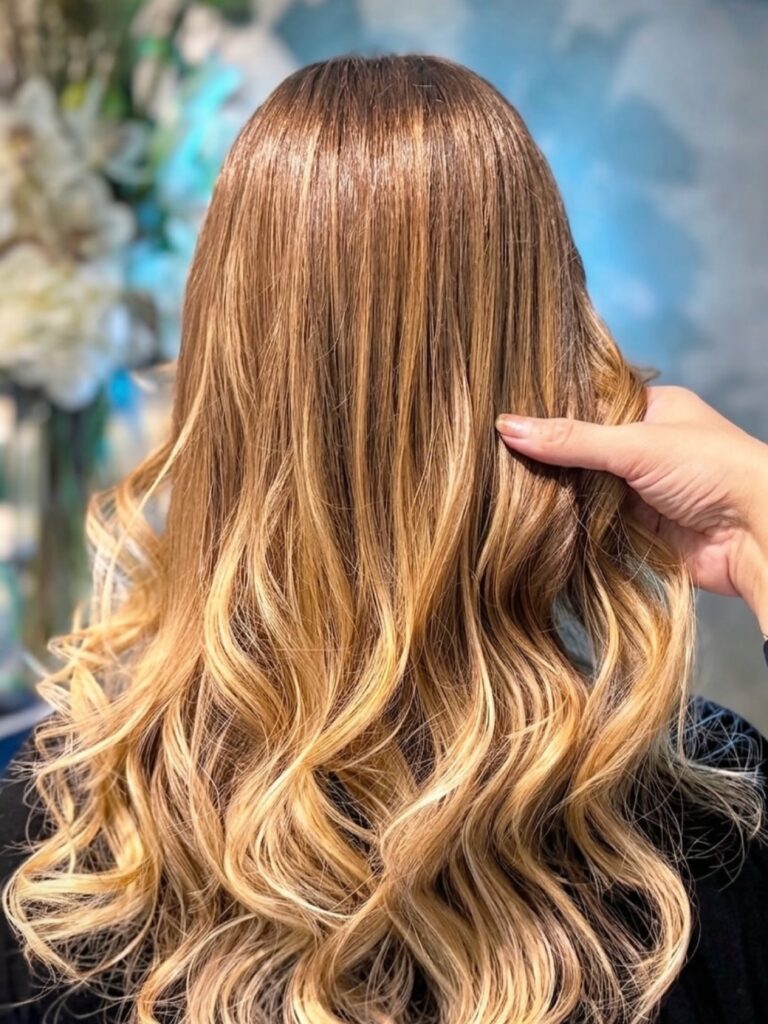
We will take a small section, usually from underneath at the back where nobody will see it, and test it. Two things get checked. The elasticity, by wetting the strand and stretching it gently to see whether it springs back or stays stretched and then snaps. And how the hair takes a small amount of the product we are considering.
That test tells us more than any conversation can. Hair that stretches and does not recover has lost its internal structure, and no amount of bond building will restore it. Hair that pulls orange or green in an unexpected way tells us there is metallic salt or old box colour still sitting in there, which matters enormously, because some home colours react badly with professional bleach.
This is also the point where we might tell you no. Not "no forever", but "no bleach today". It is not a sales problem for us to say that. It is a great deal cheaper than the appointment where we say yes and it goes wrong.
Why it cannot all be done in one sitting
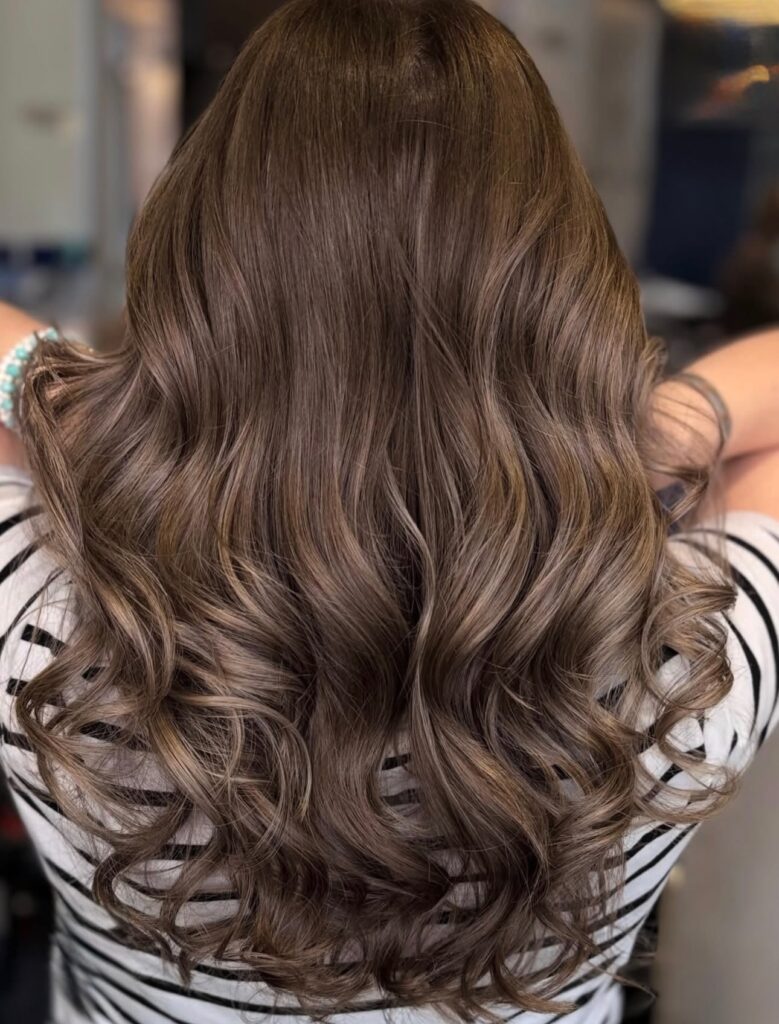
The honest answer is that most home-bleach corrections take two to four appointments across six to twelve weeks. Sometimes more, if the hair has been coloured repeatedly.
There are two reasons. The first is chemical: lifting already-damaged hair further in one long session compounds the damage rather than spreading it out, and hair needs time between processes to recover some structural integrity. The second is that most corrections are not one job. There is usually a band of dark regrowth, a mid-length that has gone brassy, and ends that are lighter and more porous than everything else. Making three different histories match takes staged work, because each part reacts differently to the same product.
What we can usually do on day one is make it wearable. A toner to kill the worst of the brass, a treatment, and a plan. You will leave looking a good deal better than you arrived even though you are nowhere near finished.
Sometimes cutting is the honest answer

This is the part people brace for, and it is worth saying plainly: if the ends have gone gummy, cutting is not us giving up. It is the only thing that works.
Hair is not living tissue. It cannot repair itself, and neither can we repair it in the way the word suggests. Bond builders like Olaplex and K18 are genuinely useful, and we use them heavily during correction, but what they do is reconnect broken bonds within hair that still has enough structure left to reconnect. Where the cortex has liquefied, there is nothing left to hold together. Product on that hair buys you a few days of feeling smoother and then it goes back to snapping.
Usually we are talking about two or three inches, not a crop. And in almost every case removing the dead ends makes the whole head look better immediately, because the damaged section was dragging the shine and the shape down. If a cut is needed we will show you exactly where, on your own hair, before anything is picked up.
Why it costs what it costs
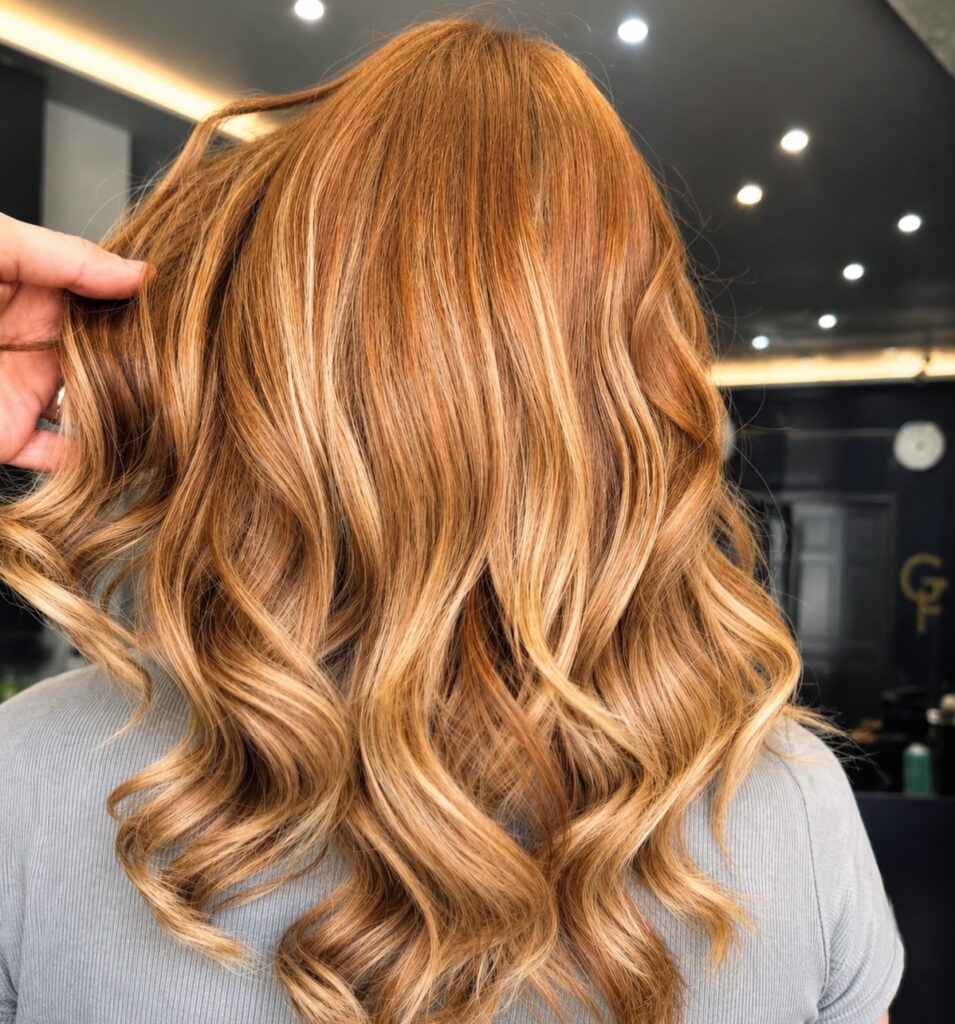
Colour correction is priced by time rather than by service, because there is no standard version of it. A straightforward one might be a couple of hours. A significant one can be five or six hours across multiple visits, with two colourists on it for part of that.
What you are paying for is not really product. It is a trained eye deciding, section by section, what each part of your hair can take, and someone watching it develop the whole time rather than leaving it on a timer. That judgement is the entire job, and it is why the same head of hair can be a straightforward correction in one pair of hands and a disaster in another.
We will give you a full estimate at the consultation, before you commit to anything, along with a rough number of appointments. If the honest answer is that growing it out with regular trims and a gloss will serve you better than a full correction, we will tell you that too.
If you are currently wearing a hat about it, book the consultation. It costs nothing and it will almost certainly be less bad than you think. Book at Oxford Street | Book at Covent Garden