Do You Actually Need Olaplex? A Buyer’s Guide
Bond treatments are everywhere, Olaplex on every salon shelf, K18 in every influencer routine, Wella Fusion sold over the counter. What none of them tell you is when bond-building actually solves your problem and when it doesn't. This guide is for people who want to know whether to spend the money before they spend it.
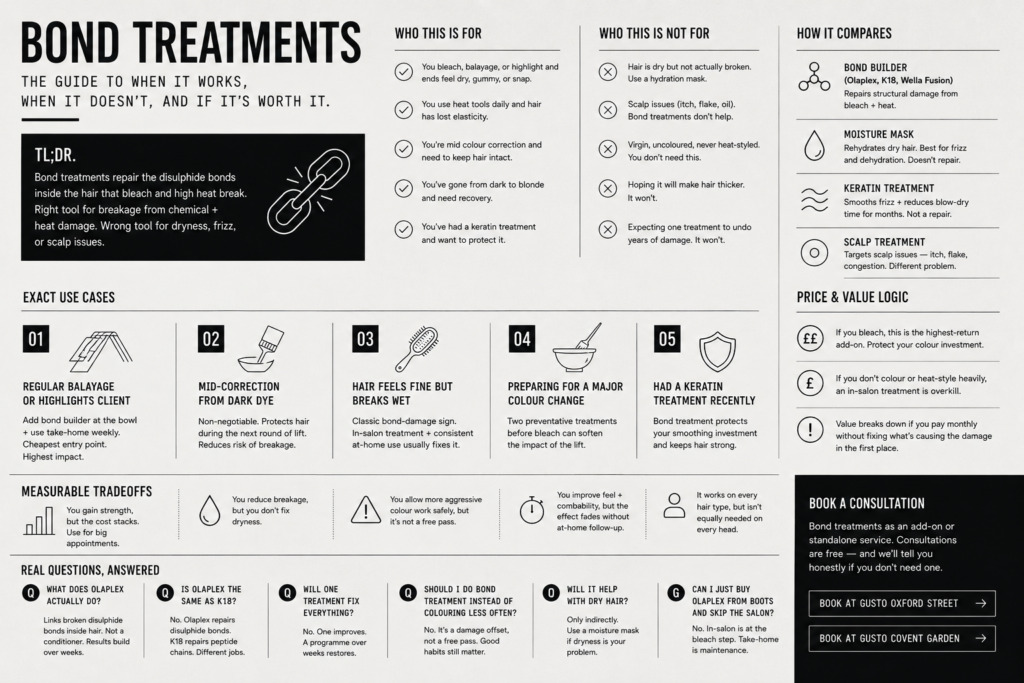
TL;DR. Bond treatments repair the disulphide bonds inside the hair that bleach and high heat break. They are the right tool for chemically lightened hair, daily heat use, and breakage at the mid-lengths. They are the wrong tool for dryness, frizz, or scalp issues — different problem, different product.
Who this is for
The buyer who gets the most out of a bond treatment usually ticks at least one of these boxes.
- You bleach, balayage, or highlight and your ends feel dry, gummy, or snap when wet.
- You use straighteners or tongs daily and your hair has lost elasticity.
- You're mid-way through a colour correction and need to keep the hair intact for the next round of lift.
- You've gone from dark to blonde and need recovery before the next session.
- You've had a keratin treatment recently and want to protect the smoothing investment.
Who this is not for
Most blog posts skip this part. Here it is.
- Your hair is dry but not actually broken. You want a hydration mask, not a bond builder.
- Your problem is the scalp — itch, flake, oil. Bond treatments don't go near that.
- Your hair is virgin, uncoloured, never heat-styled. You don't need this. We'll tell you.
- You're hoping it will make your hair thicker. It won't. Bond repair is structural, not cosmetic volume.
- You expect one in-salon treatment to undo years of damage. It improves the hair measurably. It doesn't time-travel.
Exact use cases
Concrete scenarios. If one of these sounds like you, the service fits.
You're a regular balayage or highlights client
The most common use case. A bond builder added at the bowl during your colour appointment, paired with a take-home product to use weekly between visits. This is the cheapest entry point and the highest-impact one — it protects an expensive colour result.
You're mid-correction from dark box dye
Bond builders here are non-negotiable. Without one, the second round of lift risks snapping the hair off. With one, the hair has a chance of holding through the appointment.
Your hair feels fine but breaks when you brush it wet
Classic bond-damage signature. A standalone in-salon treatment, followed by a few weeks of consistent at-home use, usually resolves it. Wet-brushing carefully helps too.
You're preparing for a major colour change
Two preventative treatments in the weeks before bleach can soften the impact of the lift itself. Worth doing if the change is dramatic — say, going from black to blonde.
Measurable tradeoffs
Every service has a cost beyond the price tag. These are the real ones for bond treatments.
- You gain measurable strength, but the cost stacks if you add it to every visit. Treat it as protection for big appointments, not a standing add-on.
- You reduce breakage, but you don't fix dryness. If hair feels parched rather than fragile, you want a moisture treatment instead.
- You allow more aggressive colour work safely, but it isn't a free pass to overprocess. Damage compounds whether you Olaplex or not.
- You improve combability and feel, but the effect fades over a few weeks without follow-up at home. The take-home step matters.
- It works on every hair type, but isn't equally needed on every head. A consultation before buying matters more here than for most add-ons.
How it compares to the alternatives
Three treatments people confuse with bond-building. They solve different problems.
- Bond builder (Olaplex, K18, Wella Fusion): repairs structural damage from bleach and heat. Best for chemically lightened or heat-stressed hair.
- Moisture mask: rehydrates dry hair. Best for frizz and dehydration. Cheaper and works faster — but does nothing for structural damage.
- Keratin treatment: smooths frizz and reduces blow-dry time for months at a time. Best for thick, coarse, or curly hair. Not a repair treatment.
- Scalp treatment: targets the scalp barrier — itch, flake, congestion. Different problem entirely. If your hair feels fine but your scalp doesn't, start here.
Price and value logic
Here's how to think about whether bond treatment is worth it for you.
If you bleach, this is the highest-return add-on on the menu. Your colour appointment already costs hundreds. Protecting the result is rational. Skipping the bond builder to save the add-on cost and then booking a corrective appointment three months later when the hair snaps is poor maths.
If you don't colour or heat-style heavily, an in-salon bond treatment is overkill. A solid deep-conditioning mask from any decent brand will do.
Where the value breaks down: paying for an in-salon bond treatment monthly without addressing what's breaking the bonds in the first place. The treatment is the repair, not the prevention. Both matter.
What you actually need to know
The honest answer to "do I need this" is: it depends what your hair is doing. Bond treatments are real chemistry, not a marketing trend — but they're sold to people who don't need them as often as they're sold to people who do.
If you're already a regular colour client at Gusto, ask your stylist directly whether your hair would benefit. We'd rather not sell you a treatment you don't need, because it makes the times we do recommend one mean something.
Real questions people ask
What does Olaplex actually do?
It links broken disulphide bonds inside the hair shaft — the bonds that bleach, perm chemicals, and high heat break. It is not a conditioner. You won't feel it after one use the way you feel a mask. You will notice over a few weeks that wet hair stops snapping.
Is Olaplex the same as K18?
No. Olaplex repairs disulphide bonds. K18 repairs peptide chains. Both have evidence behind them. Your stylist picks based on what your hair needs, not on what's trending.
Will one treatment fix everything?
No. One treatment improves the hair. A programme of treatments restores it. Plan for several weeks of consistent use.
Should I do bond treatment instead of colouring less often?
No. Bond treatment is a damage offset, not a free pass. Pair it with sensible heat use and reasonable colour cycles. The treatment supports good habits — it doesn't replace them.
Will it help with dry hair?
Only indirectly. Healthier bonds hold moisture slightly better. But if your problem is dryness rather than damage, a moisture mask is the right tool — and it's cheaper.
Can I just buy Olaplex from Boots and skip the salon?
You can buy the take-home Olaplex No.3 anywhere. But the most damaging step in a colour service is the bleach itself. That's where the in-salon bond builder goes in, added at the bowl. Take-home product is the maintenance step, not the main event.
Book a consultation
Both Gusto Hair salons offer bond treatments as both an add-on and a standalone service. Consultations are free — and we'll tell you honestly if your hair doesn't need one.